Drama League Award Nomination!

AMERICAN DREAMS has been nominated for a prestigious Drama League Award for Outstanding Interactive Theatre!

The Drama League Awards, the oldest theatrical honors in North America, will celebrate its 87th year by recognizing the extraordinary excellence in digital and socially-distanced theatrical work created during the COVID-19 pandemic. Based in New York City and historically honoring Broadway and Off-Broadway productions, this year’s ceremony has been redesigned to amplify the resiliency, experimentation, and innovation of the theatrical community across the country, in a year unlike any other in our history.

Foregoing historic categories to better reflect the digital and socially-distant work made during the COVID-19 pandemic, the 2021 Awards Nominees were selected by the 400+ alumni of The Drama League’s programs for directors and theater artists. These alumni include Tony and Emmy Award winners, artistic directors at more than 60 theater companies across the United States, and noted industry professionals.

Voting by Drama League Members begins on Tuesday, March 30, 2021, and winners will be announced via the pre-recorded and virtual Awards event on Friday, May 21, 2021.

American Dreams was first premiered at the Cleveland Public Theatre and was scheduled to tour in 2020. When the pandemic hit, the show's creative team, with the JKW Foundation's support, retooled the show as a fully online interactive show. As the pandemic took hold, more and more theatres joined the online tour, filling up the entire fall and stretching coast to coast, making it one of the biggest theatrical events of 2020.

The American Dreams tour was conceived by Leila Buck, Amanda Cooper, Jens Rasmussen, and Tamilla Woodard and lead produced by Working Theater in NYC. Partner theatres included: ASU Gammage, Texas Performing Arts, Round House Theatre, Salt Lake Acting Company, TheaterWorks, and Marin Theatre Company.


BLOODWORK - Currently in Development


A collaboration between Jens Rasmussen and Lucy Flournoy. After years of working together on various projects, BLOODWORK emerged from discussions around what audiences will need on the other side of the pandemic. The next developmental phase will happen in the Spring of 2021. 

WASHINGTON POST - “American Dreams” makes you soul search

A vigorous live-streamed interactive play that ponders and satirizes America’s naturalization policies. Able actors add humor, liveliness, and intensity. The varied format is bracing, as is the interactivity.

American Dreams has a New Presence!

After an acclaimed premiere, American Dreams is entering a new phase!

As part of the goal to bring this work to as many people as possible a new website www.AmericanDreamsPlay.com has been launched.

On the site, you can learn about American Dreams, how it was created, as well as read reviews, and meet the creative team.

Check it out and share.

SEEN BY/EVERYONE - Talkin' Broadway Review

Everything about the production works.


You might expect Seen / By Everyone, the new work at HERE by the collective known as Five On A Match, to be a comic satire, drawing as it does from actual postings on various forms of social media. Even the physical setting, a karaoke bar with the audience members seated at club tables on two sides of the performance space, suggests a fun evening of catty eavesdropping. Surprisingly, however, what unfolds through disjointed conversations (its creators refer to it as a "collage" rather than a play) is an emotionally powerful portrait of love and loss, and of individuals coming to grips with both. 

 Kudos, to begin with, to the members of Five On A Match (Matthew Cohn, Amir Darvish, Meg MacCary, Enormvs Muñoz, and Jen Taher) for both the tremendous amount of effort they must have put in to pull together a coherent whole from the world of sources available to them. And even more plaudits for the respect with which they have treated the revelatory material, representative of real if unidentified people trying to make sense of their lives in the public forum of social media. 

 The bar where the evening unfolds is called Acheron, named for the mythological "river of pain" across which souls are ferried to the underworld. Two of these souls, each of whom has died suddenly and unexpectedly, are seated at, or, in the case of one of them, sprawled across the bar among the living mourners. The conversations that unfold around them tell of shock, pain, fear, and longing over the deaths, as well as other stories of loneliness and failed relationships.

Fortunately, not all is unrelentingly bleak. There are touches of humor, foolishness, self-indulgence, bar gossip, and karaoke singing to mitigate the core of sadness. The production is also blessed with a pitch perfect cast that includes the members of Five On A Match, along with another half dozen performers, almost all of whom are experienced Equity actors. They have done an excellent job of developing their characters out of the raw material of Twitter, Facebook, and other messaging sites, so that we are able to differentiate among them and follow their separate story lines through the evening. 

Everything about the production works because everything has been carefully planned, down to the monogramed matchbooks, flowers, and candles on the café tables, along with the physical movement of the cast members across the stage, the selection of the karaoke numbers and appropriately non-professional singing, as well as Oana Botez's costumes, Ray Sun Ruey-Horng's video projections, and Christopher Heilman's set design. All told,Seen / By Everyone decidedly rises above its non-linear performance roots to tell an emotionally honest and compelling story that sticks in the mind long after viewing it. 

Theatre Review by Howard Miller - June 7, 2016

MYGRATIONS - Follows a Human Herd Across Serengeti


Every spring, over 1.3 million wildebeest rapidly travel hundreds of miles across the Serengeti. Starting out from the dry southern Serengeti plains, they have one goal in mind, and that is to reach the lush, thick grasses of the Maasai Mara in Kenya. This is no easy feat for the animals, and literally tens of thousands of the wildebeest will never make it as they journey through some of the most dangerous environments imaginable.


Besides dodging several apex predators such as lions, leopards, hyenas, and crocodiles, the terrain alone is enough to stop many. Mountains, deep ravines, impassable bogs, scorching plains, and raging rivers also stand in their way. Through sheer drive and determination, the wildebeests do somehow manage every season to make it to their destination. So how will a team, or herd, of 20 men and women fare as they attempt to complete the same journey on Mygrations?

This human Mygrations “herd” will set out on foot and will be unarmed. 


On Mygrations, their daunting goal is to reach the Mara River in Tanzania, and it will take the Mygrations team approximately six long and perilous weeks. According to Real Screen, this Mygrations group will not have navigation tools like a map or compass to help keep them on track. Like the wildebeest, the Mygrations team must travel the well-worn path that has been stamped into the ground by billions of hooves over several centuries.


Pop Tower shared that for this intriguing series, the Mygrations herd is made up of individuals with diverse backgrounds and skill sets. The Mygrations team is comprised of ex-special operations forces, survivalists, athletes, farmers, and others. Being prepared is key to completing the journey, and the Mygrations participants will load their packs with as much food and water as they can carry. The Mygrations group will also seek advice and guidance from a native tribe before starting out on their dangerous Mygrations trek.


From the very first episode, which is aptly titled “Into the Unknown,” the Mygrations participants will be dealing with thirst, predators, and each other. Early on, it becomes very clear that not everyone on this Mygrations journey can endure the hardships. With a Mygrations group this large, there are also bound to be several arguments and disagreements. A leader and pecking order of sorts will be imperative for this Mygrations herd if they are to be successful.


No matter how prepared the Mygrations herd may be, their numbers will dwindle as individuals begin to tap out due to exhaustion, hunger, injuries, illness, and extreme fatigue. Each loss is a blow to the Mygations team, but eventually, an elite group will emerge that is willing to push past the many difficulties and dangers they must endure on Mygrations.


The remaining Mygrations herd will be forced to face a wide range of dangers such as crossing hippo and croc-infested waters, scaling sheer cliffs, or figuring out how to get past a soaring waterfall. Throw in an unexpected threat from poachers and it all adds up, making a grueling journey for the Mygrations group even worse.


Can this Mygrations team make it to the end without cracking under the strain? They will certainly test the very limits and capability of what the human spirit and sheer strength of will can overcome and accomplish. This is definitely no walk in the park for these Mygrations individuals, as they must come together as a true “herd” in order to complete their journey across the wilds of the Serengeti.


Mygrations is produced by October Films for the National Geographic Channel. Executive producers for Mygrations are Jos Cushing, Matt Robins, Chris Muckle, and Doug McCallie for October Films. For the National Geographic Channel, Matt Renner is vice president of production for Mygrations, and Tim Pastore is global president of original programming and production.


Will you be watching Mygrations? Do you have what it takes to complete such a hazardous journey? There will be six hour-long episodes, and the series premiere of Mygrations airs on Monday, May 23 at 9 p.m. ET on the National Geographic Channel.

Workshop and Ars Nova Reading

How do we to survive family trauma? This documentary verbatim theatre piece explores one family that has had more than its fair share: addiction, rape, neglect, and 12 year old boys getting shot in the head.

Through a very collaborative process creator/director Aubrey Snowden worked with Leah Anderson, Amanda Dolan, Megan Gaffney, Brough Hanson, Judy Molnar, Annie Worden, and Jens Rasmussen to disassemble and reassemble the piece and explore the narrative structure.

The result of those 4 days of work was then presented in public reading at Ars Nova.


New Chapter - Bechdel Project Founding Artist

Having been involved with the creation of many new programs and ventures over the years, few have excited me as much as BECHDEL PROJECT.

This non-profit company is dedicated to telling stories on stage and screen that pass the Bechdel Test.


If you are unfamiliar, there are three criteria to the Bechdel test:
  1. The story must have at least 2 women.
  2. Who talk to each other.
  3. About something besides a man.
Unfortunately a large percentage of the stories produced today do not meet these simple criteria. In other words, little has changed since Virginia Woolf wrote in A Room of One’s Own:  “fictitious women, are too simple — contrary to the living, breathing, complex women of real life, (they) are almost always depicted only in their relation to men.”


Chimamanda Adichie describes well what she calls "The danger of a single story," a fiction that can warp the way we see the world, and our place in it. The Bechdel Project believes it can play a pivotal role in changing the conversation by advocating for and creating new works that tell stories of multi-faceted women that are not just ‘in relation to men.’


This mission is not only good for our society - it is good for our business. We know that women make up a solid majority of theatre and film audiences, so it shouldn’t be surprising that research has found that stories passing the Bechdel test do significantly better at the box office.

Bechdel Project is a marriage of art and activism, education and economics. We hope you'll join us. In fact, we're throwing a party so you can!

BECHDEL PROJECT Rooftop Launch Party! 
October 3rd! Limited Space - get tickets today!

$15 Admission ($20 at door) includes:
We look forward to celebrating this new beginning with you and more of NYC's best artists and creators!


GET YOUR TICKETS NOW!
ROOFTOP LAUNCH PARTY!


Giving Back to Brooklyn

Thanks to Urban Outfitters, BreakThruTV's Chelsea White got to take a paddle with Jens Rasmussen, founding member of the North Brooklyn Boat Club, and learn about their programs.

Watch the video below for a quick and humorous peek into to this surprising and scrappy community organization, dedicated to getting people on the NYC waterways and protecting those waters.


To see more about Jens' outdoor adventures in NYC and beyond check out the videos and links on this page.

Winter's Tale: Delightful, Whimsical, Joy to Watch

Joneal Joplin and Jens Rasmussen
Despite a mauling by a bear and the death of a child, Notre Dame Shakespeare Festival’s production of “The Winter’s Tale” has a delightful, whimsical tone that makes it a joy to watch.

Under Drew Fracher’s direction, it’s very much a visual production, both in the kinetic blocking that makes much of Act II a medley of physical comedy and in the show’s set and costume design.

Written late in Shakespeare’s life and classified as a “romance,” “The Winter’s Tale” begins as a tragedy and ends as a comedy and feels like an upside-down “Romeo and Juliet” in that respect, including its focus on the adults instead of the young lovers.

With Fracher’s production, Shakespeare’s tale of Sicilia’s King Leontes’ irrational jealousy and its dire consequences — his son’s, his wife’s and an honorable nobleman’s deaths, the end of a life-long friendship with Bohemia’s King Polixenes — turns on contrasts and humor.

As a prologue, Fracher establishes an urban, aggressive tone for Sicilia with a dance at court by four women whose appearance is best described as starched and whose choreography has a militaristic undertone to it.

Marcus Stephens’ set for Sicilia extends that tone with its sparseness, gray walls and vertical blinds that hang above the sides and back of the stage, their shadows appearing to look like prison bars cast across the stage.

By contrast, his Bohemia is a world of nature, filled with trees and foliage, while the back wall disappears and is replaced by a bright blue background.

Similarly, costume designer Christine Turbitt gives the Sicilians a formal, restrictive look, while the Bohemians’ clothing has an earthy and free-flowing look to it.

Fracher further delineates the differences between Sicilia and Bohemia with his use of music: The opening dance sequence relies on loud, recorded percussion instruments and has an assaultive quality to it, for example, while the young people’s folk dance in Act II utilizes violin, viola and guitar played by members of the cast and brings the community together in celebration.

But Fracher’s use of humor provides the most subtle and obvious contrasts between Sicilia and Bohemia.

Leontes, who defies the Oracle of Apollo, and the Bohemian pickpocket Autolycus both operate outside the law, and each is a primary source of humor in this production, one as the object of the humor, the other as the engine for it.

Although Leontes’ jealousy may be unfounded, Grant Goodman makes the character’s sense of betrayal genuine, as he does Leontes’ paranoia, but he rarely and only late in Act I brings the king to a state of rage.

Instead, he plays the jealousy with an understated tone — it’s all delivered as asides — that’s both reasonable in its delivery, if occasionally cutting, and, as a result, humorous, as if Fracher and Goodman are commenting on how illogical Leontes’ jealousy is by bringing it to the fore and poking fun at it.

The engaging Giles Davies, by contrast, plays Autolycus as a happy-go-lucky all-around rogue — both in his winking delivery and his large, flowing movements that make the audience believe Autolycus improvises his way through life — whose crimes fit into the genre of comic caper.

Davies’ free-wheeling comedy invites the audience to relate to Autolycus as co-conspirators, whereas the rational demeanor Goodman brings to Leontes creates humor but also creates tension and makes the audience nervous.

Although the rest of the cast in major roles turn in the sort of performances that appear effortless but rely on precise technique, two performances standout, in particular:

As Paulina, an engrossing Wendy Robie is intense and provides the production its moral center with the sense of conviction and power she brings to the role.

L. Peter Callender, double-cast as Antigonus (the epitome of honorable in his depiction) and The Old Shepherd is a joy to watch as the latter, with Callender bursting with life and dance in the role.

As for the bear, it’s giant, furry, growls and, thanks to Kevin Dreyer’s lighting design, is outlined by lightning flashes during the storm that make it look even larger and fiercer because it becomes more of a giant blur and shadow than a distinct creature.

Teaching Movement for Performers

One of my great joys is teaching movement.

After strength and control, my curriculum focuses on helping students fully inhabit their bodies. On this foundation students then learn to listen to, and with, their bodies. Finally the students advance to using their bodies as expressive instruments.

The class in the video below spent four hours in my movement studio learning my exercises. After learning the song in their musical theatre class we took 90 minutes to build and rehearse this piece which was then performed for this recording immediately after.

Notre Dame Shakespeare Festival

Jens is excited to again join forces with director Drew Fracher, with whom he's done two award winning
productions (Skin Tight and Gruesome Playground Injuries.) Together with an outstanding cast that includes Giles Davies, Grant GoodmanShanara Gabrielle, Wendy Robie, and Joneal Joplin he will be appearing in the Notre Dame Shakespeare Festival's production of The Winter's Tale.


'The Rebuild' World Premiere

The Rebuild at NYLA International Film Festival
Catch Jens Rasmussen's most recent film performance at the NY-LA International Film Festival. This world premiere screening of The Rebuild will be on May 9th at the Producer's Club in New York City. Get tickets here.

The Rebuild is the story of Erin (Paige Barr), a young widow who wants to move forward by scattering her late husband's ashes on New York's East River. She falls for local carpenter Jake (Jens Rasmussen), who paddles her out on the river, but soon learns she's not the only one trying to rebuild her life.

Directed by the award winning Okke Rutte, and also featuring Tony Wolf, Debargo Sanyal, and Malorie Bryant.

NY Times Review: Alexandra Collier’s ‘Underland’ Mines Rich Performances

Jens Rasmussen and Georgia Cohen
Anyone who has ever lived in a deadly dull town will understand why two bawdy-mouthed Australian schoolgirls dig a hole to China in Alexandra Collier’s “Underland.” It’s the only way out, they decide, from stone-quarry country. But they’re bad at geography, so the nice man who crawls out of their tunnel one day is from Tokyo. Back at school, the girls’ physical education teacher turns into a crocodile.

Ms. Collier, who is Australian-born and New York-based, has created six vivid, droll characters. In Terra Nova Collective’s polished production of “Underland” at 59E59 Theaters, Mia Rovegno has directed six assertive, beautifully delineated performances. The meaning of the play, however, is swathed in enough metaphor to suffocate Samuel Beckett.

Some motives are obvious. The tunnel diggers, Violet and Ruth (Angeliea Stark and Kiley Lotz), seek escape, sometimes through drugs. Taka (Daniel K. Isaac), the Japanese visitor, just wants to go home, as soon as someone brings him a glass of water, please. His Tamagotchi pet dies.

The teachers are less transparent. Miss Harmony (Georgia Cohen) is new in town, and no one can figure out why she’s there. Mr. B (Jens Rasmussen), whose instructional style suggests Marine boot camp, is also literally a killer. There are sightings in town of a real crocodile, but maybe it’s just Mr. B after his nighttime transformation.

Mrs. Butterfat (a very funny Annie Golden), though, appears to be the theme-speaker, while talking to her dead husband, Glen. “Crocs. They’re just down there, waiting,” she says. She dismisses a divine-retribution explanation of why so many locals are dying: “It’s not God; it’s the land. It’ll swallow you whole.” Aha! Living in a horrible place can eat your soul.

Rasmussen... as ruggedly, athletically entrancing as he is dangerous

Jens Rasmussen and Angeliea Stark
Underland, director Mia Rovegno and playwright Alexandra Collier's new play on stage now at 59E59 Theaters, starts as any coming-of-age teen story might. Two girls, Violet and Ruth, clad in school uniforms, light up a joint behind their school, share gossip and insults and curse words, brag about how little they care, and plot their escape from the humdrum, backwater Australian town in which they live. The rest of the play’s backbone is similarly recognizable: a beautiful young art teacher, Miss Harmony, comes into town and wants to inspire the students, catching the eye of the world-weary, cynical gym teacher Mr. B. But then the familiar façade begins to slip, and the crass but endearing normalcy of the high school scene quickly gives way into something far more sinister and dark, as this coming-of-age tale in the outback spirals into a backwoods nightmare. A Japanese businessman crawls out of a hole that Violet and Ruth had been digging out behind the school, and people start turning up dead in the gaping quarry.

Georgia Cohen is naively sweet as the fresh-faced, hopeful Miss Harmony; it’s understandable why both the younger and older generations are drawn to her. Violet, played with convincing teenage angst by Angeliea Stark, falls for her in a big way, in part because Miss H encourages her artistic ability and gives her a camera, suggesting that her art could be her escape to somewhere new. Mrs. Butterfat also falls for her, recognizing her younger self in the woman. Annie Golden's portrayal of this unapologetically eccentric religion teacher -- who doesn’t seem particularly religious at all -- may be the highlight of the play, in part because she’s laughable in her oddball ways, from carrying on conversations with her long dead husband to zipping up her bright yellow windbreaker and heading out on long bike-rides in the dark of the night. She does her best to help Daniel Isaac’s very lost businessman Taka, and console Kiley Lotz’s confused and fearful Ruth, but they may be beyond saving. Her vigilance and endless quirks might be what it takes to survive in a desert town of extremes, from the scorching heat to the frigid cold of night, where crocodiles roam the streets and from which it seems there may be no escape.

In true horror story tradition, supernatural forces jar loose to wreak havoc and seem poised to drag us all down to hell, or at least to far, far away places. Yet it isn’t all impossible, and part of Underland’s depth is its ambitious commitment to remaining a vague, unsettling allegory about the things that are out to get girls alone at night and the terrifying allure of monsters. As Mr. B, Jens Rasmussen plays this ambiguous role well, and with surreal choreography that adds elegance and seduction to the play’s threats, he is as ruggedly, athletically entrancing as he is dangerous.

The intimate scale of the space makes way for Elisheba Ittoop's sound design, which pairs the natural, sans-microphone vocal performances with eerie a capella lullabies, the insidiously maddening drone from the quarry creeping throughout, from a subtle background hum to a piercing shriek. Burke Brown’s lighting and Gabriel Hainer Evansohn’s set design create a space that transforms through subtle, powerful shifts, from the metallic, prison-like confines of the schoolyard to a suggestion of the incongruously vast, beautiful expanse of the outback's open sky.

These elements weave together into an impressively immersive environment that is, in a word, scary. But Underland is the best kind of scary. It's the kind of scary that's so hard to describe but so easy to recognize. It's the kind of scary that you don't notice at first, that creeps in around the edges, capable of capturing the audience in its jaws and swallowing them whole.

by Emily Galwak for Stage Buddy

Rasmussen is both a dangerous and erotic presence

Jens Rasmussen & Georgia Cohen
The Australia of TV commercials: the Great Barrier Reef, the Sydney Opera House and swoon worthy landscapes, is nowhere to be found on the stage at 59E59 where Underland has opened. Instead this is the industrial desert of the outback, all red earth, tin buildings, the throbbing of the quarry and a vague undercurrent of dread. It is this Australia, by turns comedic, tragic and a bit confusing, in which Underland plays out.

In this landscape, a school is the one place that offers the possibility of something unusual happening. And waiting for that unusual thing are two school girls, Ruth and Violet. Violet is small town mean girl, playing at being a rebel. Ruth is her long time friend and co-conspirator, happy to be part of a group but always worried about the consequences. Angeliea Start as Violet and Kiley Lotz as Ruth bring these characters effortlessly to life. They both want, desperately, for something to happen in this tiny hamlet. And something does.

Two strangers arrive at school. The first, Miss Harmony, is a new Art Teacher that spies promise and talent in Violet. They slowly begin a mentor relationship that gives Violet hope for a better life. Georgia Cohen gives life to Miss Harmony, a teacher hoping to reach her students. Violet responds well to the attention of this new, enthusiastic teacher. However Miss Harmony has another vying for her attention, the school alpha-male teacher, Mr. B. As portrayed by Jens Rasmussen, Mr. B is both a dangerous and erotic presence.

Ruth finds her own stranger in the form of Taka, a Japanese salary-man who arrives in the middle of nowhere via a tunnel from Tokyo. Taka is confused and lost, but Ruth is ecstatic to have found something completely new. Daniel Issac as Taka does an amazing job by pretty rapidly helping the audience move past the bizarreness of his appearance in Australia and care about this man. But Ruth has a competitor for attentions of Taka, the long widowed Mrs. Butterfat. Mrs. Butterfat is excellently played by the veteran Annie Golden; she walks Mrs. Butterfat right to the line of caricature, without going over.

If this makes Underland seem confusing, just wait. Writer Alexandra Collier throws in salt-water crocodiles in subterranean rivers, late night biking, a killer in thrall to the hum of the earth and ruminations on the choices we make when growing up. The result is often confusing but always involving. Director Mia Rovegno never lets the story slip into farce or fantasy, always preferring an honesty that someone makes the whole story hang together.

I am not sure I understood Underland, but I am sure that I am rooting for Violet and Ruth to make the right choices. And that engagement with characters makes for a satisfying trip to the theater.

See original review at Whats on Off Broadway.

Jens Rasmussen is quite striking

Jens Rasmussen & Georgia Cohen
It's not often that a playwright sets out to mystify an audience as resolutely as Alexandra Collier does in Underland. The setting is "a small, dusty town in the middle of Australia," and believe me, this Underland is no wonderland. Drought conditions prevail. There are warnings about crocodiles, reportedly moving ever closer to town in search of water. People have a way of turning up dead or disappearing altogether. And what about the man who staggers on stage at the opening, looking disturbed and pulling a bloody tooth from his mouth?

Following this ugly display, the play switches gears, focusing for a while on Ruth and Violet, a pair of adolescent girls who dabble in smoking pot and gossiping maliciously about everyone they know. Violet is the prettier, more dominant one, to whom Ruth anxiously kowtows, but they make a perfectly matched pair of hellions, amusing themselves by sitting in the back of art class and making annoying meowing sounds while their new teacher tries to introduce herself.

The teacher, Miss Harmony (Collier favors names right out of Restoration comedy), is new to town; in one of the play's sharpest, funniest passages, her easygoing, let's-be-friends manner is contrasted with the scalding, hard-ass approach of the gym and math teacher, Mr. B. ("You're like flaccid wombats, the lot of you," he says, offering his own special brand of motivation.) It's not long before a little B-Harmony romance is in the air; at the risk of giving away too much, let's just say that she discovers that passion has its price.

Then there's Taka, a Japanese salaryman sitting in his Tokyo office, listening to exercise audios and playing with his tamagotchi, a tiny little digital pet that, in this case, meows like a kitten. He finds a hole in his floor and, getting inside, begins crawling along it until he exits -- in the Australian town inhabited by Ruth, Violet, et al.

As Ruth and Violet, Kiley Lotz and Angeliea Stark offer hair-raisingly accurate portraits of the kind of sullen, rebellious adolescent who makes one think fondly about reviving corporal punishment, but each of them gradually reveals layers of uncertainty that make them more than just caricatures. Jens Rasmussen is quite striking as the furious, tough-talking Mr. B., who harbors a powerful, all-consuming passion for Miss Harmony, and is also in possession of a terrible secret.

-Read the whole review by David Barbour at Lighting & Sound America

Chatting at the E:Bar with... Jens Rasmussen

What’s something unexpected or surprising that you learned about Australia through doing this play?
There are crocodiles in Australia’s interior AND that digging “to china” is inexplicably universal even though digging through the center of the earth from the Australian interior really lands you closest to Puerto Rico. So where do kids in China dig to?
What word do you say to key in to your Australian accent?
Two words actually - Don’t Smile. But just to be clear, I do actually smile in the show - well, not that much come to think of it…
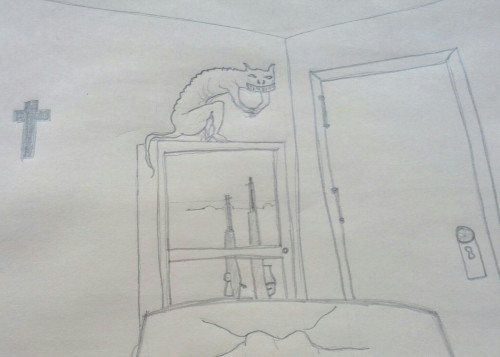
Describe your childhood imaginary friend or foe. Can you draw a picture for us?
I had a reoccurring nightmare: in the dream my mother and I would finish saying my evening prayers in my bed (a bed which came from a nunnery by the way), she would tuck me in and close the door to my bedroom. Behind my bedroom door was a gun cabinet (for real - not just in the dream). When the bedroom door was closed the gun cabinet was revealed and in the reoccurring dream a demon would be sitting on top of the gun cabinet. I was trapped with no way out. I would wake up screaming. Good times.
image
Drawing of my reoccurring childhood nightmare 

Where is your home town? Did you ever want to escape from it?
My home town is Oshkosh, Wisconsin. I actually didn’t ever feel trapped there. We lived by one of the largest lakes in the state, and my folks got me a second hand windsurfer. Windsurfing is one of the most incredible feelings of freedom a person can experience. We also spent lots of time on the small farm my father and grandfather owned together. When we didn’t have chores, my younger brother, Hans and I would crawl through the woods and swamp making up adventures. Lastly, and maybe most importantly, my parents always had international guests staying with us: people from Iran, Israel, South Africa, New Zealand, Finland, South America, and many more. My folks always gave us a good view of the horizon beyond out little town, and the tools to tackle it on our own when we were ready. All my siblings and I went out on our own at 18 and never came back.
What’s your favorite Australian animal and why?
If I had to pick just one one it’d be the Dingo - misunderstood, intelligent, loyal, survivor now hunted and endangered. A close second would be Sugar Glider - can you handle the cuteness? https://youtu.be/FSx__5yIrmc
This interview was originally published on the 59E59 blog

People You Should Know... Jens Rasmussen


An UNDERLAND interview by Zack Calhoon, originally posted on his site


UNDERLAND at 59E59

When did you know that you wanted to be an actor?
 
I had one of those magical Catholic high school choir teachers who loved Rod Stewart, believed in me, and gave me opportunities to grow. If it hadn't been for her - I shudder to think what might have become of this boy from Oshkosh with buck teeth and a Lego obsession.

Tell me about UNDERLAND. How do you feel rehearsals are going? What do you love most about the show?

UNDERLAND is wonderful. It's part Jerusalem, part Mean Girls, with a dash of Alice in Wonderland and Frankie and Johnny in the Clair de Lune. Rehearsals have been an absolute joy. Mia runs a beautiful room and brought together an amazing group of artists. Every designer and every actor has impressed me. I'd be excited to do any project with this group of artists. What I'm loving most about the show right now, is the moments we're building that bend time and space, in surprising, and I hope, compelling ways.

What kind of writing inspires you?

I adore writing that feels natural yet elevated and Ally's writing has this kind of muscular lyricism. My absolute favorite experiences in the theatre is when a piece moves me, and yet I can't verbalize why. Then I know the writer has peeled back a layer of my experience at the very edge of my understanding. It's exhilarating and maybe a little scary.

Who or what has been the biggest influence on your work as an actor thus far?

I think of actors like Michael Lague, who I looked up to when I was an apprentice over 20 years ago, or Michael Chekhov's writing, which I went back to over and over again, or brilliant actors like Mark Rylance, whose work constantly inspires me. But oddly enough, at this point. I think students have influenced my work the most. It's really true that teachers learn and students teach. Being in a studio with young actors has been a great facilitator to my own understanding of my work and process, as well as a tremendous source of inspiration.

What else are you working on right now?

In addition to UNDERLAND at 59E59, I'm in pre-production for THE LITTLE PRINCE which I'll be directing this summer in Georgia, and doing initial prep for A WINTER'S TALE which I'll be performing in at the Notre Dame Shakespeare Festival.

Rasmussen... brave, talented, absolutely perfect

Sometimes I go to the theatre with the intention of sitting back and being entertained. Sometimes I don’t want to have to think too much and sometimes I just want to laugh a lot. Well, I laughed a few times during The KNOW Theatre’s brilliant production of THE TWENTIETH CENTURY WAY, but I certainly didn’t get to sit back during this frenetic 90 minutes of intensity.

I’m not even sure how to describe the show to you. The description I’d read doesn’t really tell the full story of what this play is. And I absolutely will not spoil it for you. But suffice it to say, what I thought I was going to see – a show about two out of work actors hired to trap gay men into arrests in the 1920s – is way understating it.

The friend who went with me – who is himself a brilliant actor – helped me understand the show in a different context. He said it was a show about acting. He’s right . . . but upon further reflection, I think that it is a show about truth. Raw, naked, intense, real, authentic truth and how that truth is experienced on stage and off by actors.

Jens Rasmussen and Michael McKeogh were absolutely perfect in their portrayals of multiple characters. There were jarring transitions but not once was I lost, thanks to the deft directoral hand of Kimberly Faith Hickman and the marvelous performances. These are brave actors, to be sure, and talented ones. I will be lining up to see them perform again.

The KNOW has another knock out hit with this show. If they can continue to produce MainStage masterpieces like PLUTO and THE TWENTIETH CENTURY WAY under the artistic leadership of Andrew Hungerford then they are going to be a force to be reckoned with. You should see this show – but don’t come unless you’re willing to work for it. It does pay off and in spades.